


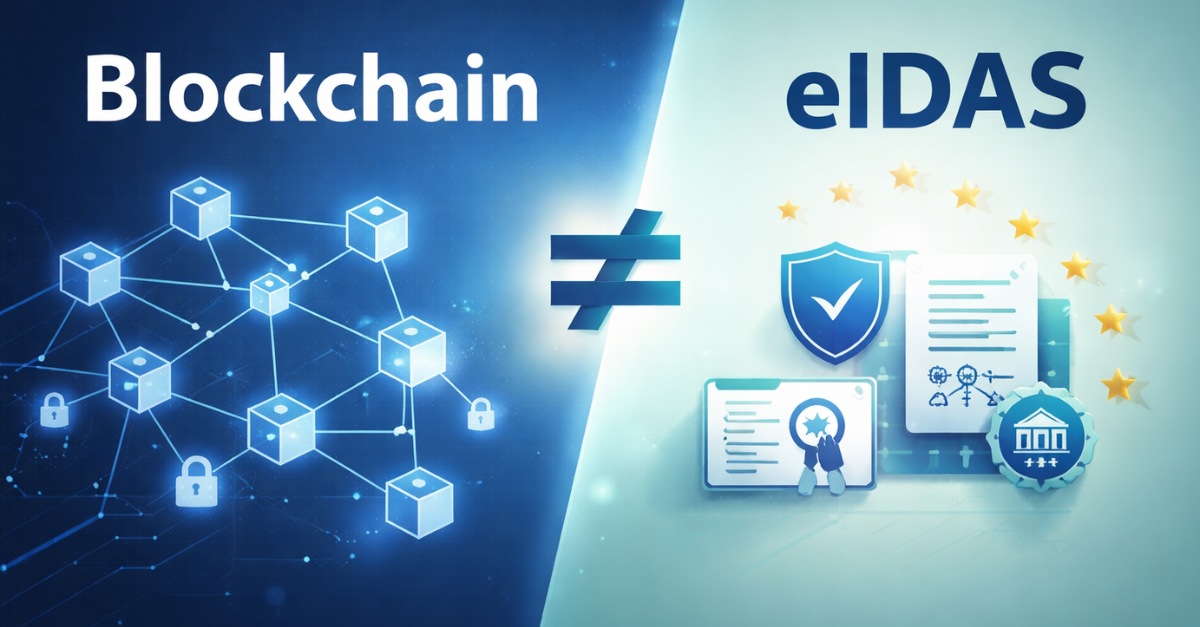
When we talk about “certifying” digital content — websites, posts, emails, images, videos, audio files, documents — two distinct concepts often appear and are frequently used as if they were equivalent: Blockchain and eIDAS. And they are not.
Understanding what each one really means makes the difference between having technical evidence or a solid and defensible piece of evidence in court proceedings.
Let’s break it down.
What Is Blockchain and What Does It Contribute to Digital Content Certification?
Blockchain is a technology that allows information to be recorded in a shared and verifiable manner, so that any subsequent modification can be detected.
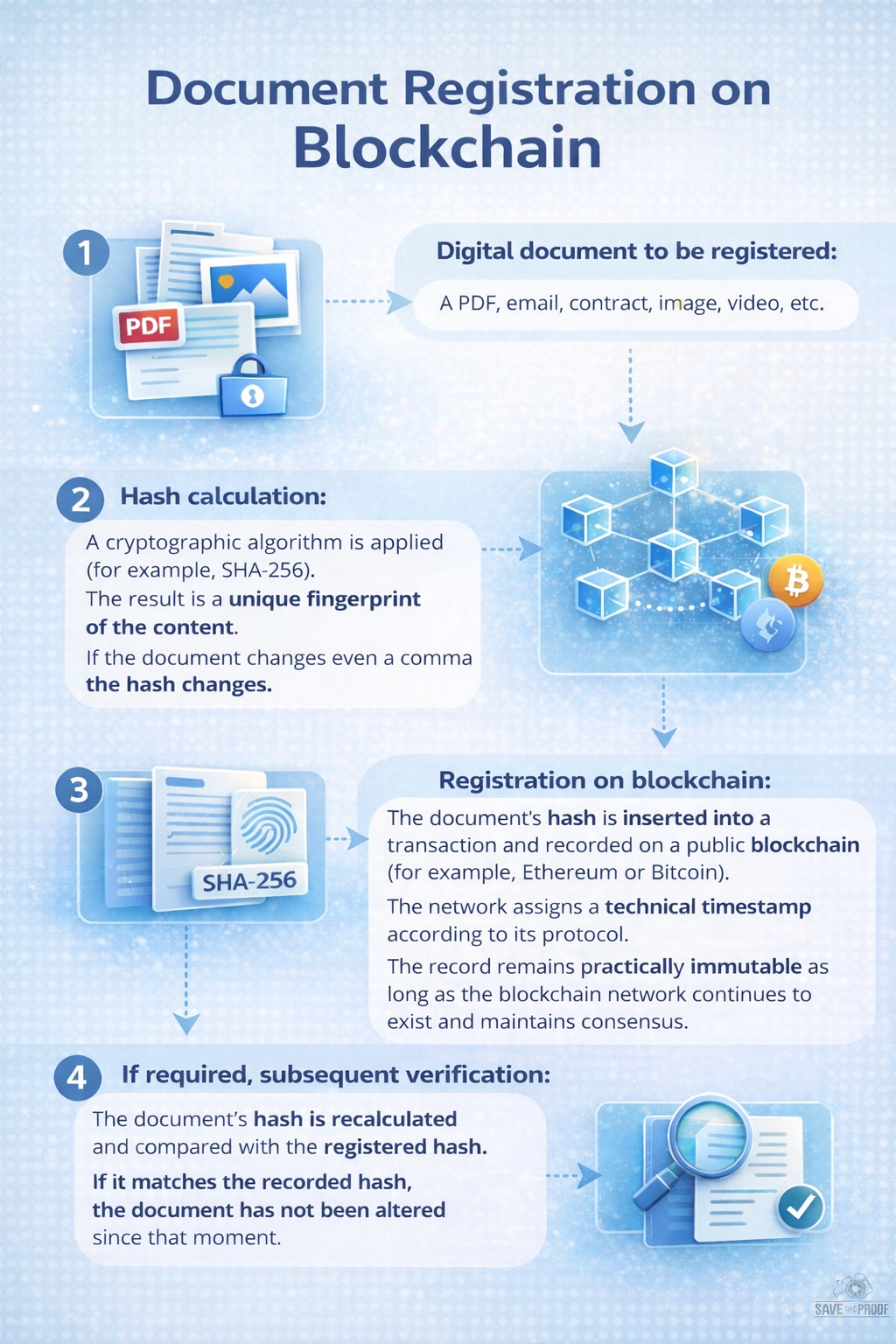
In digital content certification, blockchain is mainly used to anchor a hash, that is, the cryptographic fingerprint representing the content of a document.
📌 Blockchain does not certify documents in a legal sense. What it does is register technical evidence.
Information is organized into blocks linked together (hence the name blockchain) and distributed across a network of nodes — computers connected to each other — that monitor one another.
The more independent nodes there are, the lower the technical risk of altering the record.
Trust in this model is technical in nature, not legal: blockchain reinforces the integrity of the record, but does not by itself generate legal validity or legal presumptions.
Let’s look, in very basic terms, at 4 points how blockchain works when applied to digital documents:
The Key Role of Nodes (and Why It Matters)
Nodes are the computers that make up the blockchain network. They are the ones who verify and maintain the information. Therefore, blockchain security is not absolute, but largely depends on the number of nodes and their independence.
When a network has many independent nodes, it becomes much more difficult and costly to manipulate the information.
By contrast, in networks with few nodes, private networks, or those controlled by a single entity, there is a greater risk that it may be possible to coordinate efforts to alter or rewrite the data.
Under certain circumstances, what is known as a 51% attack may occur, which happens when a person, entity, or group gains control over the majority of the network’s validation capacity. In such a scenario, it would be possible to alter the order of blocks, prevent certain transactions, or even create alternative versions of the chain.
Therefore, the robustness of a blockchain does not depend solely on the number of nodes, but also on who controls them, how they are geographically distributed, and the consensus mechanism used.
📌 Blockchain security is based on technical and economic assumptions that make it more difficult to alter the record of a digital document, but it does not constitute a legal obligation or guarantee of its validity as evidence.
What Does a Blockchain Record Actually Prove (and What Doesn’t It)?
✅ Blockchain DOES prove:
-
-
- Integrity: the content has not been modified since a given point in time.
-
-
-
- Existence at an approximate moment in time.
-
❌ Blockchain does NOT prove:
-
-
- Who the author is of the content or who originally created it.
-
-
-
- That the content is lawful, truthful, or legally valid.
-
-
-
- The identity of the signer, since the cryptographic signatures used in blockchain are not linked to a legally recognized identity under eIDAS.
-
-
-
- Consent, understood as the acceptance of the content by an identified person through an electronic signature with legal effect.
-
⚠️ It is not correct to say that blockchain “certifies” something legally. The accurate statement would be: “There is technical evidence on the blockchain proving that this document existed and has not been modified since a specific date.”
⚠️ It is not correct to equate a hash recorded on blockchain with an eIDAS-compliant time stamp.
⚠️ It is not correct to claim that something “complies with eIDAS” solely because it uses blockchain.
(*) The above does not invalidate the evidence, but it does affect its evidentiary weight and typically requires expert technical explanation.
Does Blockchain Have Legal Validity as Evidence?
In Spain and in the European Union, the use of blockchain can have evidentiary value, but it does not benefit from automatic legal presumptions. The fact that evidence is recorded on a blockchain does not prevent it from being submitted in legal proceedings, as a piece of evidence cannot be rejected merely because it is electronic.
However, its specific evidentiary weight is determined at the judge’s discretion. If the evidence is challenged, it will normally be necessary to explain how the system used operates, provide expert technical evidence to demonstrate its reliability, and properly justify the chain of custody of the document or digital evidence.
📌 Blockchain is not regulated as a trust service.
eIDAS: What Is It and Why Is It Different?
eIDAS is the European Regulation that governs trust services, not technologies, provided by identified, audited, and supervised entities.
In the field of digital content certification, eIDAS mainly relies on two instruments:
- Electronic signature (advanced or qualified), which allows a document to be linked to a duly identified natural or legal person,
- Electronic time stamp, especially a qualified one, which legally establishes a specific point in time.
And what does a qualified eIDAS time stamp provide? A qualified time stamp under eIDAS offers key legal effects:
-
Legal presumption of the accuracy of the date and time,
-
Presumption of the integrity of the content from that moment,
-
Identification of a legally responsible service provider.
Thanks to these presumptions, the burden of proof is reversed: it is up to the party challenging the certificate to demonstrate that it is not valid.
📌 eIDAS does not regulate blockchain.
An eIDAS trust service may use blockchain internally, but legal validity derives from the service provider and the service itself, not from the technology.
Key Differences Between Blockchain and eIDAS
| Aspect | ⛓️ Blockchain | ⚖️ eIDAS |
|---|---|---|
| 📜 Nature | Technology | Legal framework |
| 👤 Legal responsibility | ❌ No | ✅ Yes |
| ⏰ Presumption of date | ❌ No | ✅ Yes |
| 🔒 Integrity | 🔎 Detectable (hash) | 🛡️ Legally presumed |
| ⚙️ Technical dependency | ⬆️ High (nodes, consensus) | ⬇️ Low |
| 🧑⚖️ Need for expert evidence | ⚠️ Medium / High | ✅ Low |
| 🏛️ Strength in court | 📌 Contextual (depends on the case) | 💪 High |
How Does SaveTheProof Work in This Context?
At SaveTheProof, we apply a proof-oriented approach, not merely the generation of technical evidence. To achieve this, we use advanced electronic signature (LTV) and qualified time stamping in accordance with eIDAS, so that the result can be relied upon before third parties and used in legal proceedings.
The objective is not only to demonstrate that digital content existed, but also to provide it with legal presumptions regarding its integrity and its date.
In practice, the certification process with SaveTheProof.com consists of:
As a result, a digital certificate is obtained that constitutes a robust, clear, and defensible documentary evidence, supported by digital signature and time stamping in accordance with eIDAS, and endowed with legal presumptions that significantly reduce the need for expert evidence.
Conclusion
Blockchain and eIDAS do not compete, as they do not play the same role.
Blockchain allows technical evidence to be recorded, reinforcing the integrity and traceability of digital content. However, it does not certify documents nor generate legal presumptions.
eIDAS, by contrast, establishes a legal framework recognized throughout the European Union that turns digital content into documentary evidence, providing it with legal presumptions regarding its date, its integrity and, through electronic signature, consent.
When what is at stake is evidence, the difference lies not in the technology used, but in the legal backing that supports it.
Certify your digital content today with SaveTheProof.com with legal validity under eIDAS.
Do you have questions? Contact us at [email protected] or use the chat on our website. We’ll be happy to help. 😉