


Information security is essential for any business that handles digital data and documents. Protecting this information requires effective security measures and proper risk management.
ISO 27001 certification demonstrates that an organization meets international requirements for managing information security within a defined scope.
At SaveTheProof, we have achieved ISO 27001 certification. This represents another important step in our ongoing commitment to security, data protection, and the trust of our users.
In this article, we explain what this certification means, the benefits it provides, and how it relates to our legally valid digital evidence certification services.
What Is ISO 27001 Certification?
ISO/IEC 27001 is an international standard that establishes requirements for securely protecting and managing an organization’s information.
It was developed by the International Organization for Standardization (ISO) and the International Electrotechnical Commission (IEC).
Its purpose is to help organizations establish and maintain an Information Security Management System (ISMS).
An ISMS is a framework of internal policies, processes, and security measures designed to identify risks and protect information against potential threats.
Therefore, achieving ISO 27001 certification means that an independent certification body has verified that an organization’s information security management system meets the standard’s requirements.
This assessment covers specific activities, processes, and systems, collectively known as the certification scope.
The current reference edition is ISO/IEC 27001:2022. In 2024, an amendment was published addressing the consideration of climate change within the organizational context.
ISO 27001 is internationally recognized. According to the ISO Survey 2024, there were 96,709 ISO/IEC 27001 certificates and 179,877 certified sites worldwide.
These figures highlight the standard’s global importance, although they do not necessarily represent the number of individual certified companies.
What Is ISO 27001 Used For, and What Are Its Requirements?
ISO 27001 helps organizations protect their data and systems through a structured approach to information security management.
It involves much more than installing antivirus software or securing computer equipment. The standard also requires organizations to define responsibilities, assess risks, and regularly review their security measures.
To achieve these objectives, ISO 27001 establishes several requirements:
- Define what needs protection: identify the information, systems, and processes included within the information security management system.
- Assign responsibilities: establish who is responsible for implementing and overseeing security measures.
- Assess risks: identify potential threats to information and evaluate their possible consequences.
- Implement security controls: select appropriate safeguards to reduce or manage identified risks.
- Conduct audits: periodically verify that security measures are effective and that the standard’s requirements are being met.
- Continuously improve: address weaknesses and adapt the management system to emerging threats and changing business needs.
The standard also includes a reference set of information security controls. Each organization must determine which controls are appropriate based on its identified risks and justify its selection.
Confidentiality, Integrity, and Availability of Information
ISO 27001 is built around three fundamental principles of information security:
- Confidentiality: information should only be accessible to authorized individuals.
- Integrity: data must remain complete, accurate, and protected against unauthorized modifications.
- Availability: information and systems must be accessible whenever authorized users need them.
For example, a company must control who can access its documents, prevent unauthorized changes, and establish procedures to respond to system failures.
ISO 27001 helps organizations structure these safeguards. While it does not guarantee absolute security, it provides a systematic and verifiable approach to managing information security risks.
SaveTheProof Achieves ISO 27001 Certification
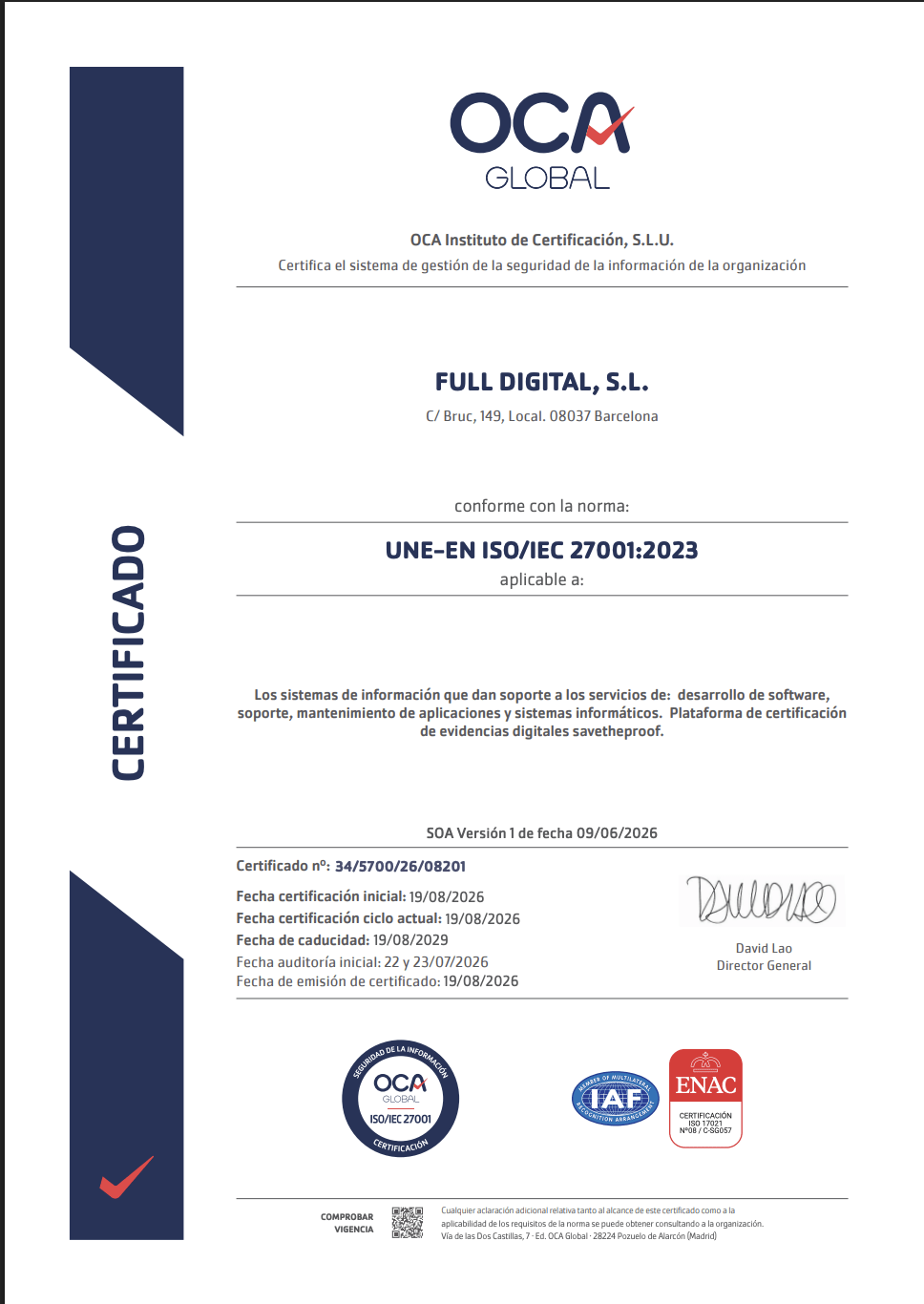
At SaveTheProof, we have successfully obtained ISO 27001 certification, an achievement that reinforces our commitment to information security.
This certification confirms that the assessed information security management system meets the standard’s requirements within the scope specified in the certificate.
For us, security is an essential part of our services. Every day, we help professionals, businesses, and individuals preserve digital information that may be critically important.
That is why maintaining clear procedures for managing risks and protecting information is fundamental to our operations.
In addition, this certification complements our compliance with the Spanish National Security Framework (ENS), Medium category, within the scope established in the corresponding certificate.
Both certifications reflect our commitment to responsible security management and the continuous improvement of our services.
What Are the Benefits of ISO 27001 Certification for SaveTheProof Users?
When using a digital platform, understanding how the service provider manages information security is essential.
This becomes particularly important when you need to preserve documents, websites, or other digital content that could potentially be used as evidence.
ISO 27001 certification offers several important benefits:
- Greater confidence: an independent certification body has assessed the organization’s information security management system.
- Risk management: established processes are in place to identify threats and determine how to address them.
- Documented procedures: security responsibilities and protective measures are clearly defined and organized.
- Regular assessments: the management system undergoes periodic reviews and audits to verify its effectiveness.
- Continuous improvement: the organization must regularly evaluate and update its security management system to address emerging risks.
These benefits are especially relevant for attorneys, digital forensics experts, OSINT investigators, legal departments, and businesses that handle sensitive information.
Consider a company that discovers an online post damaging its reputation. Before the content disappears, the company needs to preserve reliable evidence of what was published.
In this situation, it should evaluate both the process used to certify the online content and the security practices of the platform providing the service.
ISO 27001 certification provides confidence in the provider’s information security management practices. Digital evidence certification, meanwhile, documents the content through specific technical mechanisms.
These are two distinct functions that can complement each other.
ISO 27001 vs. ENS vs. Legally Valid Digital Evidence Certification: Key Differences
Although these concepts are all related to digital security and trust, they are not interchangeable.
Understanding their differences is important to determine exactly what each certification verifies:
- ISO 27001: certifies that an information security management system meets international requirements within a defined scope.
- Spanish National Security Framework (ENS): establishes security requirements for information systems falling within its scope of application in Spain.
- Digital evidence certificate: documents electronic information through processes involving data capture, timestamping, and integrity protection.
ISO 27001 and ENS focus on information system security and its management. Digital evidence certificates serve a different purpose.
These certificates can be used to document digital content and provide technical information that helps verify specific characteristics of the evidence.
At SaveTheProof, we use mechanisms such as advanced electronic signatures, technical metadata, and qualified electronic timestamps, depending on the characteristics of each service.
A qualified electronic timestamp links data to a specific date and time through a service regulated under European legislation.
The eIDAS Regulation grants qualified electronic timestamps a legal presumption of accuracy regarding the indicated date and time, as well as the integrity of the associated data.
However, this does not mean that every piece of digital evidence will automatically be admitted in court or that its authenticity cannot be challenged.
The legal assessment of digital evidence depends on its content, the procedures used to obtain it, and the applicable laws and rules of evidence in each case.
In short, ISO 27001 certifies an organization’s information security management system, while digital evidence certificates document electronic information using specific technical mechanisms.
How Does SaveTheProof Help Certify Digital Evidence for Legal Purposes?
SaveTheProof is a LegalTech platform that enables users to capture and preserve digital evidence online.
Our services help document digital content that may change, disappear, or become relevant in legal proceedings, disputes, or investigations.
Depending on the type of information you need to preserve, you can choose from several certification options:
- Web Browsing Session Certificate: records a browsing session using video and associated files. It is particularly useful for documenting social media posts, interactive content, and online processes.
- Web Page Certificate: captures accessible content from a specific web address. It can be used to preserve advertisements, online offers, or commercial terms before they change.
- File Certificate: documents the existence and characteristics of digital files, such as documents, photographs, or audio recordings, using identification and integrity verification mechanisms.
The certificates include technical information that helps verify when the certification process was performed and whether the preserved files retain their original data.
For example, a cryptographic hash is a unique digital fingerprint calculated from a file’s contents. If the file is modified, its hash value will generally change, making it possible to detect alterations.
The process of certifying digital evidence is straightforward:
- 1. Identify the content: determine which website, browsing session, or digital file you need to preserve.
- 2. Choose the certification service: select the certificate that best matches the type of content.
- 3. Complete the certification: follow the platform’s instructions to generate and document the evidence.
- 4. Save your files: securely retain the certificate and associated documentation for future verification.
We also provide options for businesses that need to certify digital content regularly or through automated processes.
These include WebTrack, bulk web page certification, and REST API integration, available through our Unlimited and Unlimited+API plans, depending on the features included in each plan.
Additionally, our online certificate verification tool allows users to upload a certificate and check whether it is valid and has not been tampered with.
With over 2,000 customers and more than 150,000 certificates issued, SaveTheProof has extensive experience in the digital evidence certification industry.
Achieving ISO 27001 certification further strengthens our commitment to delivering these services with information security management practices that meet international standards.
Frequently Asked Questions About ISO 27001 Certification (FAQs)
Is ISO 27001 certification mandatory in Spain?
No. ISO 27001 certification is not mandatory for all businesses in Spain. However, certain customers, contracts, or procurement processes may require it as evidence that an organization has a certified information security management system.
How long is an ISO 27001 certificate valid?
ISO 27001 certification generally follows a three-year certification cycle, including periodic surveillance audits. Its continued validity depends on maintaining compliance with the standard and the validity dates specified in the certificate.
Who issues ISO 27001 certificates?
ISO 27001 certificates are issued by independent certification bodies. ISO develops the international standard but does not directly certify companies or organizations.
What is the difference between ISO 27001 and ISO 27002?
ISO 27001 establishes the requirements an information security management system must meet to achieve certification. ISO 27002 provides guidance and recommendations for implementing information security controls.
How can I verify whether a company is ISO 27001 certified?
Check the certificate holder’s name, certification body, certificate number, certification scope, and validity dates. You can also confirm its status directly with the issuing certification body or through available certification databases.
Does ISO 27001 certification guarantee GDPR compliance?
No. ISO 27001 helps organizations manage information security, but the General Data Protection Regulation (GDPR) establishes specific legal obligations for protecting personal data.
SaveTheProof: Committed to Information Security and Digital Evidence Protection
Achieving ISO 27001 certification marks another milestone in our ongoing commitment to information security and continuous improvement.
This certification complements our expertise in capturing and preserving digital evidence, where data integrity, reliable timestamping, and technical documentation play a fundamental role.
Whether you need to preserve a website, record a browsing session, or certify a digital file, SaveTheProof offers solutions tailored to different requirements.
Explore our digital evidence certification services for legal purposes and protect important information before it changes or disappears.
TRY IT FOR FREE. Explore the platform with a seven-day educational trial. Certificates generated during this trial include a watermark and do not have legal validity.
To obtain legally valid digital evidence certificates, you must use the applicable paid plans.