


When you start researching digital certification, one term keeps coming up: qualified trust service provider.
One of the most frequently asked questions when someone starts using SaveTheProof is: Is SaveTheProof a qualified trust service provider?
It is a common question that often causes confusion, especially when talking about digital content certification, online evidence, or electronic signature.
Many of the inquiries we receive follow exactly this line of thinking:
We wrote this post precisely to put the pieces together and answer these questions.
What is a qualified trust service provider?
A qualified trust service provider is an entity that provides certain digital services defined by European regulation, such as qualified electronic signatures or qualified time stamping.
This role is regulated by Regulation (EU) No 910/2014, better known as the eIDAS Regulation, which establishes the legal framework for electronic identification and trust services in the European Union.
You can find more information or consult this regulation here: https://eur-lex.europa.eu/legal-content/EN/TXT/?uri=CELEX:32014R0910
The objective of this regulation is to ensure that certain digital services have legal recognition across the European Union.
The European Commission explains how these services work in general here: https://digital-strategy.ec.europa.eu/en/policies/eidas-regulation
What does the eIDAS Regulation say?
The eIDAS Regulation defines the European legal framework for digital trust services.
It establishes both the trust services themselves and the entities that can provide them when they meet the required standards, known as qualified trust service providers.
This regulation allows certain digital services to have uniform legal recognition across all countries of the European Union.
Which services can be qualified under eIDAS?
The eIDAS Regulation defines which types of trust services can be considered qualified, and the main ones are the following:
✍️ Qualified electronic signature.
⏱ Qualified time stamping.
📜 Qualified electronic seals.
📦 Electronic registered delivery services.
🌐 Qualified certificates for website authentication.
Web Content Certification Is NOT a “Qualified” Service
We have reached the key point of this post.
The certification of web content—that is, capturing a web page or digital content to demonstrate what was published at a specific moment—is not defined as a qualified service under the eIDAS Regulation.
⚠️ There is currently no specific qualified service in European regulation for certifying web content.
This does not mean that this type of evidence has no legal validity, but simply that it is not part of the qualified services defined by European regulation.
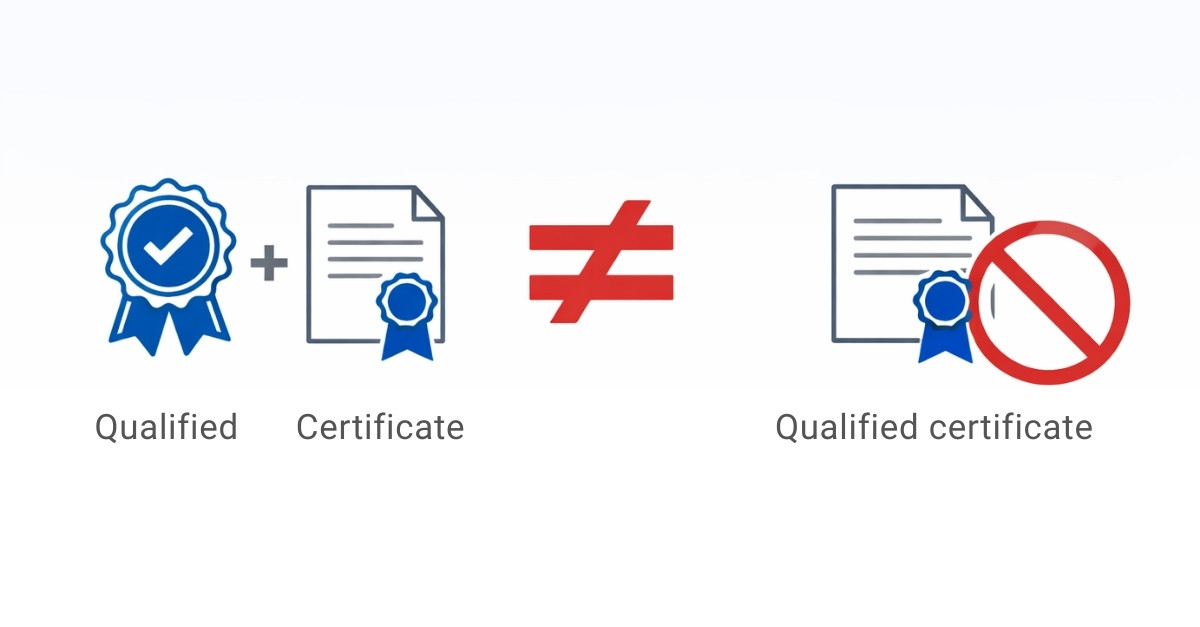
Why Are These Concepts Sometimes Confused?
Qualified plus certificate is not the same as a qualified certification.
This is where confusion usually appears… and often where a bit of marketing spin comes in.
You may find services whose commercial messaging suggests that their web content certification is “qualified”, creating the impression that it has a higher legal status.
But in reality, it does not work that way.
When a company provides qualified electronic signature and qualified time-stamping services, and also offers digital content certification services, it simply uses its own qualified services to sign the certificate and add a qualified time stamp.
Under the eIDAS Regulation, what can be qualified is the electronic signature, the electronic seal, or the time stamp — not the certification of web content.
⚠️ What is qualified is the signature or the time stamp, not the certificate.
The difference with SaveTheProof is that the qualified signature and time-stamping services are provided to us by external qualified providers.
But the outcome is the same: in both cases, the certificates have exactly the same legal validity.
So, Is SaveTheProof Qualified?
The short answer is:
⚠️ SaveTheProof cannot be either qualified or non-qualified for web content certification, because this service is not defined as a qualified service under the eIDAS Regulation.
Lo que sí hacemos es trabajar con prestadores de servicios de confianza cualificados para determinados procesos técnicos, como:
🔏 Firma electrónica.
⏱️ Sellado de tiempo cualificado.
Entre los prestadores utilizados se encuentran entidades incluidas en las listas oficiales europeas como FNMT, Izenpe o Firma Profesional.
La Comisión Europea mantiene un listado público oficial con todos los prestadores cualificados de la UE, que cualquier persona puede consultar:
https://digital-strategy.ec.europa.eu/en/policies/eu-trusted-lists
También existe una lista específica de prestadores españoles, donde encontrarás a nuestros prestadores cualificados:
https://sedediatid.mineco.gob.es/Prestadores/Paginas/Inicio.aspx
What Exactly Does SaveTheProof Do?
SaveTheProof.com allows you to capture and preserve digital content as verifiable evidence.
For example:
🌐 Web pages.
📲 Social media posts.
📰 Digital content that may disappear or be modified.
The goal is to generate verifiable digital evidence that makes it possible to demonstrate what content existed at a specific moment using any of the three digital certification tools available:
▶️ Web browsing session certificates | SaveTheProof
Legal Validity of Digital Evidence
In the digital environment, it is increasingly common to need evidence of content published on the internet, such as web pages, social media posts, or online conversations.
Although web content certification is not a qualified service under eIDAS, digital evidence can still have evidentiary value as long as it is possible to demonstrate:
Tools such as SaveTheProof are specifically designed to generate verifiable digital evidence that can be used as proof when necessary.
Frequently Asked Questions
In Summary
The term qualified trust service provider has a very specific meaning within the eIDAS Regulation and applies only to certain digital trust services regulated by European legislation, such as qualified electronic signatures or qualified time stamping.
The certification of web content, such as capturing web pages or online posts to generate digital evidence, is currently not part of those qualified services.
📌 In the case of SaveTheProof, the objective is to generate verifiable digital evidence that makes it possible to demonstrate what content existed on the internet at a specific moment. To reinforce the integrity and traceability of this evidence, the system uses technologies such as electronic signatures and time stamping provided by qualified trust service providers.
Understanding this distinction helps to correctly interpret how digital evidence and trust services operate today within the framework of the eIDAS Regulation.
Do you have any questions? Write to us at [email protected] or use the chat on our website. We’ll be happy to help you. 😉