




Cyberharassment can begin with a private message, an offensive comment, a fake account or an image shared without consent.
In these situations, the first reaction is often to delete the content, block the person responsible or immediately report the account. However, there is one important step you should take first: 🚨 Preserve the digital evidence.
A post can be deleted, a story can expire, and an account can change its name or disappear. If the content has not been properly preserved, proving what happened later may be much more difficult.
If there is no immediate risk to your safety, preserve the evidence first and take action afterwards.
What Is Considered Cyberharassment?
Cyberharassment is a form of harassment carried out through digital channels, such as social media, messaging apps, email, forums, websites or online video games.
It can take the form of:
When cyberharassment occurs among minors, it is commonly referred to as cyberbullying.
Although every situation is different, each one leaves a digital trail that can help show what happened, when it happened and which profile or account the content was posted from.
Why Should You Preserve the Evidence Before Blocking Someone?
Blocking the person responsible may be necessary to stop further communication. The problem is that, once you have blocked them, you may lose access to certain posts, comments or profiles.
The platform may also remove the content after it has been reported, or the harasser may delete the messages, change their username or close the account.
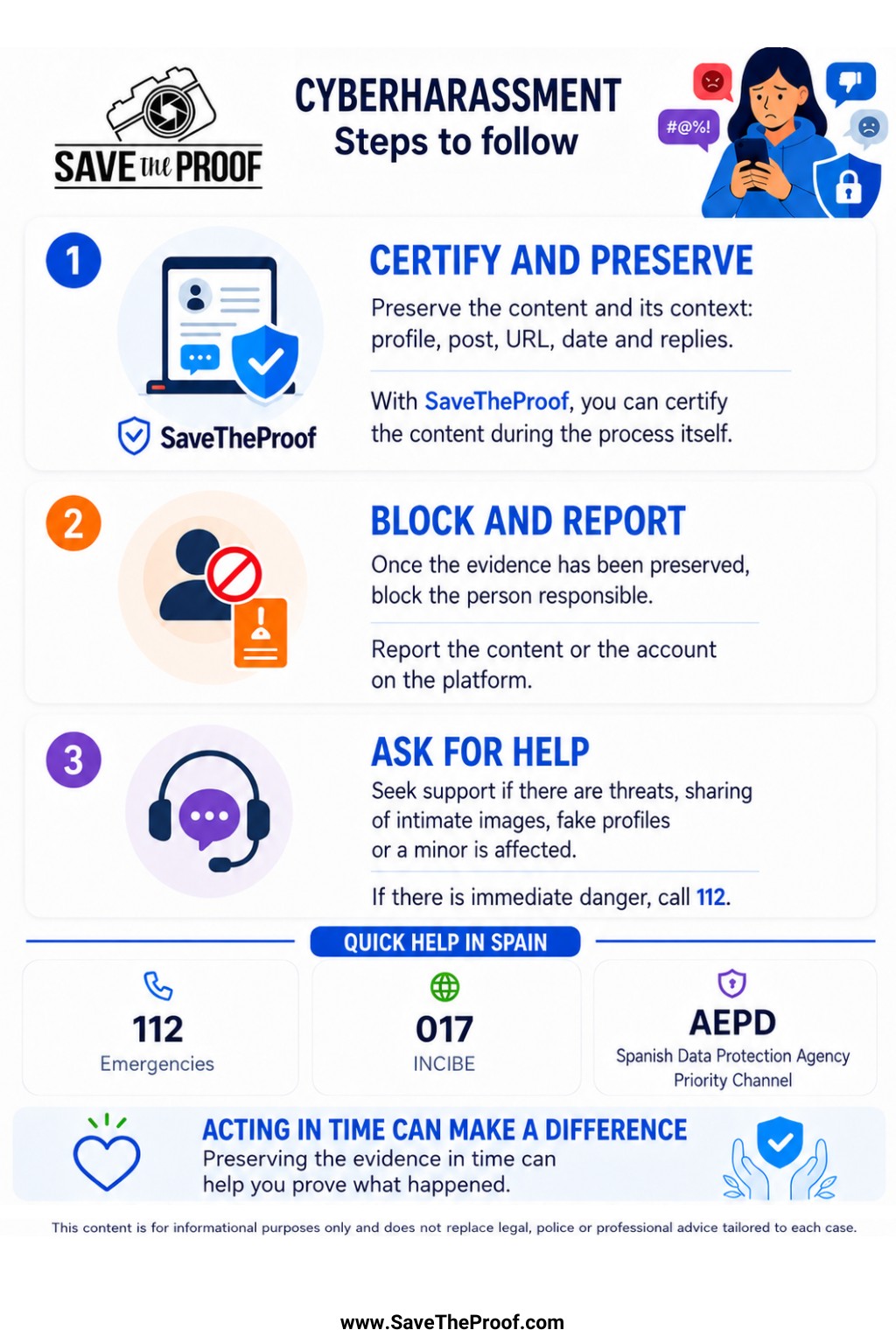
Provided there is no immediate danger —in which case the priority is to protect the person affected and seek help—, the recommended steps are:
- 1
Certify and preserve the content with its context.
- 2Block the person responsible and report the content to the platform.
- 3Seek professional help or contact the authorities when necessary.
What Digital Evidence Should You Preserve?
Do not preserve only the most serious message or post. In many cases, it is also important to show that the harassment was repeated and preserve the full context.
Try to preserve:
The evidence should allow another person to understand what happened, who posted the content and the context in which it appeared.
Is a Screenshot Enough?
A screenshot is better than preserving nothing, but it can have limitations.
It may not show the web address, the date, the full profile or the context of the post. It may also be cropped or challenged because it could have been altered.
In our article Screenshots Are Not Solid Evidence, we explain in more detail why an isolated screenshot may not be enough to prove digital content.
For this reason, a screenshot can be useful as an initial measure, but it should be supported by a system that can establish:
Simply saving what appears on the screen is not enough. It is also important to preserve the information needed to identify its source and context.
How SaveTheProof Can Help
SaveTheProof allows you to generate certificates and preserve digital evidence of online content that could be modified, hidden or deleted.
You can use SaveTheProof to certify:
With the Web Browsing Session Certificate you can access a social network, log in when necessary, and document the complete path leading to the evidence. This way, not only is an isolated screenshot preserved, but also the profile, the post, and the elements needed to understand where the content comes from.
When the evidence is publicly available at a URL, you can also use the Website Certificate to preserve the visible content of the page.
SaveTheProof certificates include screenshots of the certified content, technical information and metadata of the process, an advanced electronic signature, and a qualified timestamp compliant with the eIDAS Regulation. These elements make it possible to prove the date and time the certificate was generated, reinforce the integrity and traceability of the digital evidence, and facilitate its submission as evidence in legal proceedings.
The certificate can be provided to a lawyer, a computer forensic expert, an educational institution, a company, or an authority to assess its content.
The role of SaveTheProof is not to determine whether a conduct constitutes a crime, nor does it replace legal or expert advice. Its purpose is to help you preserve digital evidence before it is modified or deleted.
When should you ask for help?
You don’t have to face a cyberharassment situation without support. It is especially important to ask for help as soon as possible when there is:
In Spain, you can request free and confidential guidance through the 017 Cybersecurity Helpline of INCIBE.
If the case affects minors, you can also consult the cyberbullying resources of Internet Segura for Kids (IS4K) and inform the educational institution so that it can assess the situation and activate its action protocols.
When the facts may constitute a crime, you can go to the National Police or find out how to file a report with the Guardia Civil.
If sexual or violent images or videos are being shared without consent and there is a serious risk to the affected person, you can request their urgent removal through the AEPD Priority Channel.
If there is immediate danger, the priority is to protect the affected person and call 112.
⌛ Acting in time can make the difference
Online content can be edited, deleted, hidden, or disappear at any time.
Digital evidence preserved in time can help reconstruct what happened, demonstrate that the conduct has been repeated, and better defend the rights of the affected person.
If you are experiencing cyberbullying or cyberharassment, protect your safety first and preserve the evidence before blocking or reporting.
To learn more about how to certify with SaveTheProof, you can create your account and try the service free for 7 days in training mode.
Have questions? Write to us at [email protected] or use the chat on our website. We’ll be happy to help you. 😉