


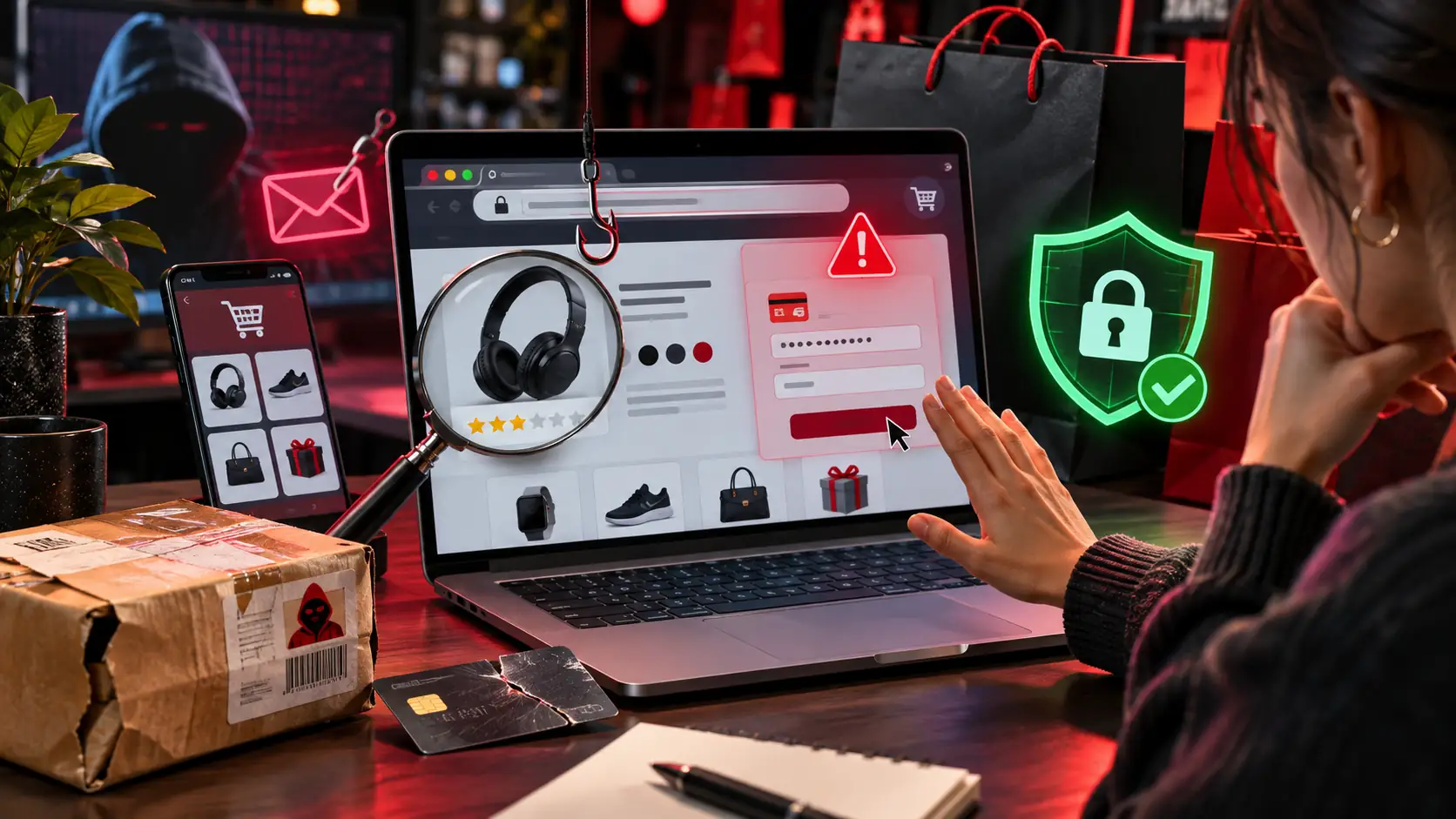
Black Friday scams can be hidden behind extraordinary discounts, fake online shops or messages impersonating well-known brands and delivery companies. Before making a purchase, it is important to recognise the warning signs.
The approach is straightforward: identify warning signs, verify the retailer, avoid unsafe payment methods and preserve evidence if you suspect something is wrong. Acting quickly is essential if you have already shared personal or financial information.
At SaveTheProof, we offer digital evidence certificates to document online content at a specific point in time. We do not determine whether a scam has occurred, but we can help you preserve digital evidence to support a potential complaint or claim.
Types of Black Friday Scams and How to Spot Them Before Buying
Phishing is an impersonation technique designed to obtain passwords, banking details or persuade users to take certain actions. Smishing uses SMS messages to carry out similar scams.
Fake online shops pretend to sell legitimate products. A misleading offer, however, may constitute a breach of consumer protection rules without necessarily establishing criminal fraud.
- Phishing emails: advertise exclusive discounts and direct users to fake login or payment forms.
- Parcel delivery scams: claim that a delivery has been held up and request a small fee or banking details.
- Impersonation websites: copy logos, photographs and designs from legitimate businesses but use different domain names.
- Fraudulent adverts: promote products at exceptionally low prices and redirect users to shops whose identity cannot be verified.
- Fake sellers: demand payment outside the marketplace or through methods offering limited opportunities to recover funds.
- Misleading discounts: display incorrect previous prices to exaggerate the advertised reduction.
Spain’s National Cybersecurity Institute, INCIBE, explains how to recognise phishing and suspicious requests for personal information. No single warning sign proves that fraud has occurred.
To shop safely during Black Friday, check the website address, the seller’s identity, the purchase terms and the available payment methods. A professional-looking website is not enough to establish trustworthiness.
- Website address: access the retailer through its official URL, entered directly into your browser. Look for similar-looking names, additional letters and unusual domains.
- Seller: check the registered company name, business identification details, address, contact information and verifiable returns policy.
- Offer: compare the price, exact product model, delivery charges and availability with other retailers.
- Urgency: be wary of messages demanding immediate payment or threatening the loss of a supposed prize.
- Payment: prioritise methods offering buyer protection and avoid transferring money directly to unknown individuals.
- Reviews: consult independent customer reviews and check that they refer to the specific seller and website.
- HTTPS: indicates an encrypted connection, but does not verify the retailer’s identity or establish that the shop is trustworthy.
In an analysis published on 3 December 2025, Spain’s consumer organisation OCU found that 89% of the crossed-out or reference prices examined did not comply with the applicable rules.
The sample covered almost 2,500 products across 61 online retail platforms. This figure concerns advertised prices, not the number of scam victims. Breaches of pricing regulations may give rise to consumer complaints.
Under Article 20 of Spain’s Law 7/1996, the previous price must generally be the lowest price applied to identical products during the preceding 30 days, subject to statutory exceptions.
To learn how to compare promotions and document price changes, read our article Black Friday: Real Deals or Just Pure Fiction?.
How to Document Suspected Black Friday Scams with SaveTheProof
Certifying digital evidence allows you to document specific content and its existence at the time of certification. This is particularly useful when an offer, price or web page may subsequently change or disappear.
At SaveTheProof, we offer three types of certificates. Each preserves different information depending on whether you need to document a public URL, an interactive browsing session or an available file.
- Website Certificate: documents publicly available offers, prices, product listings and terms and conditions. Price: €4.95, including VAT.
- Web Browsing Session Certificate: records content and interactions during an authorised browsing session. Price: €9.95 per certificate, including taxes.
- File Certificate: identifies a specific version of a file using its SHA-256 hash and certification date. Price: €0.95 per file, including VAT.
Why obtain these certificates? They allow you to preserve digital evidence at a particular point in time and obtain documentation that may support a subsequent complaint or claim.
For example, you can document an advertised price, promotional terms, delivery times or the content of an online shop before that information is changed.
- Product price: preserve the published offer so you can compare it with the amount eventually charged or advertised later.
- Promotional terms: document discounts, dates, delivery charges and restrictions published by the seller.
- Online shop: preserve the business and contact information displayed before it is potentially changed or removed.
- Checkout process: document authorised screens and interactions if you need to preserve terms that are not visible on a public URL.
- Received files: certify exported documents or communications to identify their contents and check their integrity later.
To preserve evidence of a suspected online scam, act while the content is still accessible, without increasing your exposure to dangerous websites or compromising personal information.
- 1. Identify the information: record the URL, product, advertised price, date and relevant terms if you can access them safely.
- 2. Protect your information: never enter passwords, card details or SMS verification codes on a suspicious website.
- 3. Choose the certificate: select the appropriate service for the public web page, authorised browsing session or available file.
- 4. Review the content: check that the evidence contains the necessary information before completing certification, where the service offers a preview.
- 5. Preserve the documents: download the certificate and associated files. Keep original order confirmations, invoices, payment receipts and communications.
- 6. Verify the certificate: use our free verification tool to check the integrity of certificates issued by SaveTheProof.
Practical example: you purchase a product advertised for €199, but the seller later claims it was priced at €249. A certificate obtained beforehand can document the advertised price and associated terms.
If the retailer subsequently removes the product listing, the previously captured evidence may remain available. The certificate does not, by itself, prove that fraud or a contractual breach has occurred.
What can you do with the certificate afterwards? Use it alongside your invoice and other supporting documents to explain what information was published at the relevant time.
- When contacting the seller: attach the certificate to your complaint to document the price or conditions displayed in the original offer.
- When contacting a marketplace: submit the evidence when opening a dispute or requesting a review of a purchase made through the platform.
- When contacting consumer protection authorities: include the certificate and supporting documentation in a complaint to the relevant body.
- When contacting law enforcement: preserve the evidence for a potential criminal report if you suspect an offence has been committed.
- In legal proceedings: the certificate may be submitted as electronic evidence, subject to the applicable rules on admissibility and evidential weight.
Our certificates incorporate advanced electronic signatures and qualified electronic timestamps. Article 41 of the EU eIDAS Regulation establishes legal presumptions concerning the date, time and integrity of the linked data.
Visit our legal validity page and read our guide on how to submit a SaveTheProof certificate in legal proceedings.
What Should You Do If You Have Fallen Victim to a Black Friday Scam?
If you have already made a payment or disclosed personal information, your priority should be to limit the damage. Do not delay contacting your bank to collect additional screenshots, and avoid interacting with suspicious links again.
- 1. Contact your bank: report suspicious transactions, request that your payment card or method be blocked, and ask about refunds, chargebacks or dispute procedures.
- 2. Secure your accounts: change compromised passwords, sign out of unfamiliar sessions and enable two-factor authentication.
- 3. Preserve the evidence: retain original emails, text messages, URLs, payment receipts, order numbers and any certificates obtained.
- 4. Make a complaint or report the incident: contact the relevant consumer protection body for commercial disputes or the police if you suspect a criminal offence.
- 5. Seek guidance: if you are in Spain, contact INCIBE’s 017 helpline for free, confidential cybersecurity advice.
A consumer complaint and a criminal report serve different purposes. INCIBE’s 017 service provides guidance on digital security incidents in Spain but does not replace the relevant authorities.
Frequently Asked Questions About Black Friday Scams (FAQs)
Why Certify a Web Page When You Suspect a Scam?
It allows you to preserve content published on a particular date, such as prices, offers or purchase terms, and obtain supporting documentation for a potential complaint or claim.
What Happens If an Online Shop Disappears or Changes Its Offer?
If you obtained the certificate before the change, you can retain the captured content and its certification date. However, this does not establish why the shop disappeared.
Can a SaveTheProof Certificate Be Used as Evidence in Court?
Yes, it may be submitted as electronic evidence. It incorporates an advanced electronic signature and a qualified electronic timestamp, but its admissibility and evidential weight are determined by the relevant court.
Can I Return an Online Black Friday Purchase Even If It Was Discounted?
Yes. For most distance purchases from businesses, consumers generally have 14 days from receipt to cancel, including during Black Friday sales. Exceptions apply, including certain personalised products.
What Can I Claim If I Receive Counterfeit Goods on Black Friday?
If you bought the item from a business and it does not match its description, report the problem and seek a remedy under your applicable consumer rights. Keep the invoice, original listing and photographs.
If you suspect a Black Friday scam, follow five steps: identify warning signs, verify the seller, avoid unnecessary risks, document the evidence and take action. Preserving evidence can help support a subsequent complaint or claim.
At SaveTheProof, we help you document web pages, browsing sessions and files before their content changes or disappears. Our certificates incorporate advanced electronic signatures and qualified electronic timestamps, providing assurances of integrity and verifiable proof of timing to support potential complaints or claims.
Create your SaveTheProof account and preserve relevant digital evidence while it remains available and can be accessed safely.